Stabilizer Systems and Auxillary Sails
- Stability Studies
- Rig and Spar Design
- Stabilizer Systems
- Powering and Systems
- Structural Modifications
 Consulting takes many forms, it may involve getting my opinion on a particular boat or project or it may include planning or concept sketches and design drawings of a required modification.My work in consulting involves studies of powering, stability, control, motion, construction and arrangements. Small craft are generally anything under about 150' in length. Most of my current work concerns boats 24m and under. I work closely with associated experts including my colleagues in B.C. at CR Engineering.
 2016/03/ Current Stability Projects as of March 2016:
- Bellacra Explorer Stability Study
Fast aluminum craft, stability study following successful completion of my recommendations for structural modifications to improve performance
- Majestic Warrior Stability Study Commercial Fish Packer
- Northern Dream Stability Study and Design Modifications for Pilot House 120' Motoryacht
- IV Interceptor Stability Study 36' Commercial Troller
- Leeway Stability Study 40' Schooner
- T1 Stability Study 100' by 25' Landing Craft
- Content Stability Study 60' Motoryacht
-
Steadying and Auxillary Sails
Auxillary Sails as Stabilizers and Get Home Propulsion
This also includes adding sails or stabilizer poles to power vessels. The addition of sails as stabilizers and get home propulsion is a concept which I believe is under-utilized. Most powerboats have opted for very complex rigs (derived from racing rigs) with expense and maintenance all out of proportion to their use. This is an area that needs more work.
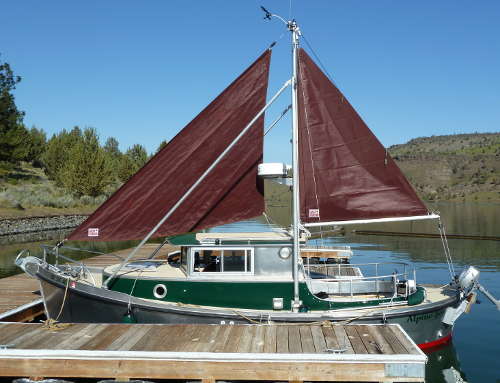
Auxillary, steadying sails on the Timbercoast Troller 22New Sail-assisted Passagemaker Lite Dawkins 62
A new ketch-rigged 62' aluminum Passagemaker Lite in the 02 series is in development. The sailing rig is designed to be folded down by the owner and kept aboard during canal cruising. It will be the largest of our current sail-assisted power designs, the Timbercoast Troller 22, Garden Bay 23, Northcoast 26, Wedge Point 27, Northcoast 34, and Ocean 55.
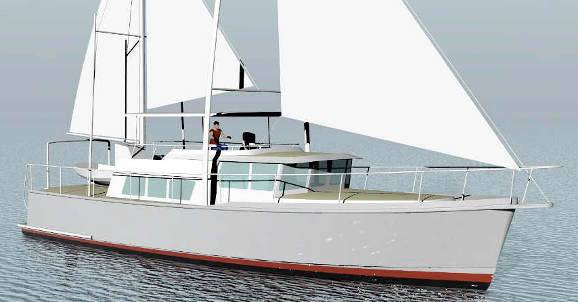
New ketch-rigged 62' aluminum Passagemaker Lite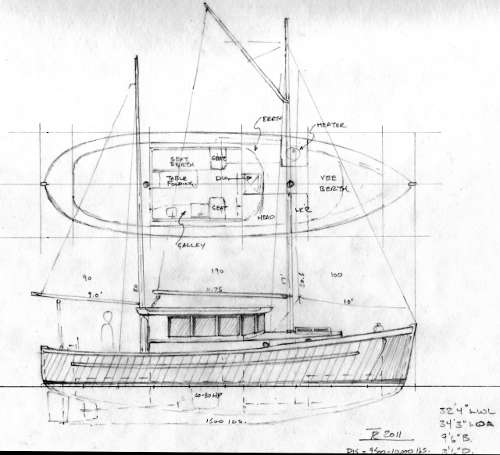
Northcoast 34: Sail-assisted power cruiser
-
Stabilizer Systems
Active Fin Keels, Booms, Paravanes
Seagoing powerboats can be made far more livable with the installation of some form of stabilizer system. One option is powered active fins and I’ve done a number of retrofits of these, including to a plank-on-frame wooden motoryacht. Booms and towed paravanes are another popular option, I‘ve created a number of these systems for both new and existing vessels. Other options are flume tanks, gyroscopes, moving weights, dagger boards, bilge keels, and steadying sails.
Roll Reduction for Offshore Cruising
Stability and roll reduction is a major concern for many people contemplating offshore cruising in a powerboat. Decent roll reduction is what makes offshore cruising (and in many cases coastwise cruising) in powerboats possible and pleasurable. Which system or combination of systems chosen for a particular boat will depend on a number of factors. However, the major factor will be area and length of planned voyages, along with the desired comfort range expected. The three most popular systems, as mentioned above, will provide varying amounts of roll attenuation. Each system also adds some resistance when the vessel is underway. Active fins and bilge keels add drag all the time, paravanes only add drag when they are deployed.
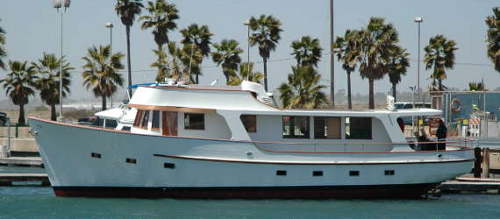
Retrofit of powered active fins to a plank-on-frame wooden motoryachtA General rule of thumb states that active (powered) fin stabilizers will eliminate about 90% of rolling, which is very good. The down side is that they are vulnerable and a complex electro/mechanical system that can break down. Many think that passive towed paravanes eliminate about 70-80% of rolling, which is great for a non-powered system. And bilge keels have a varied reputation as there are so many variations of size/style/position. Generally they should eliminate 50 % or less of rolling. The gyroscope is the newest system gaining popularity, but due to the addition of weight and huge power draw it makes little sense ultimately.
Roll Reduction for Coastwise Cruising
If I were contemplating for example a trip to Alaska up the inside passage, I would fit small fixed bilge keels. These provide some stabilization underway, but very little when the vessel is anchored. This is okay as the inside passage includes endless protected anchorages. But if you are heading for Panama or South America, I would consider a combination of all three systems. The active fins work very well underway, but need the protection of the bilge keels. The paravanes are a great backup to the active fins, and they work while the boat is anchored.
Which system or combination of systems is chosen for a particular boat will depend on a number of factors. However, the major factor will be area and length of planned voyages, along with the desired comfort range expected.
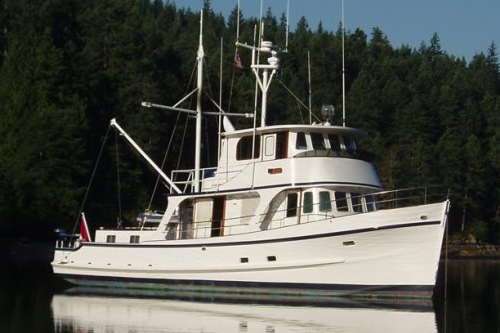
Mast and Stabilizer Redesign: Two masts, boom and paravane stabilizer system for Island Eagle-
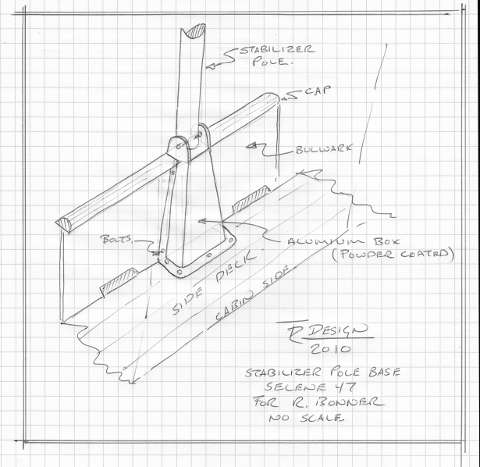
Construction drawing of a stabilizer pole base -
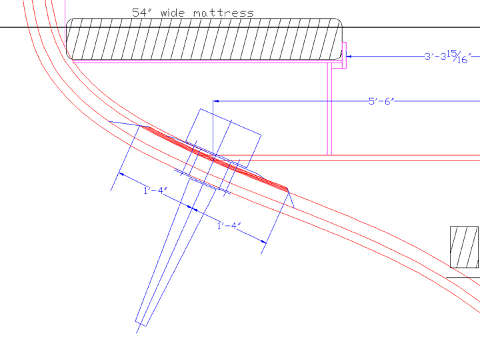
CAD construction drawing for an active fin stabilizer