Express 92 Retro Commuter

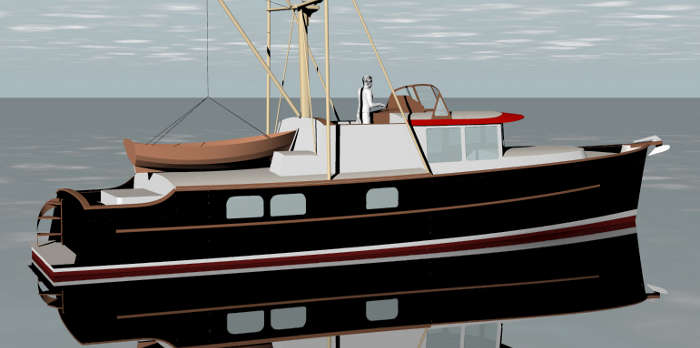
The 92 Express is an effort to maintain the stunning looks and performance of Liberty while adding the spacious interior expected in a 92' motoryacht. In the 92' I have increased beam relative to length. The 92' is still narrow by modern standards; the average is 21'-22' but this is entirely in keeping with her retro styling and performance objective. With 19' of beam her interior spaces take on the feeling of a room, rather than that of a passageway.

About

Tad Roberts Growing up on the BC coast in a family of boatbuilders, architect/builders, artists, and sailors, it was only natural that I should start drawing boats at a young age. After a decade working on tugs and fishboats, and cruising and racing sailboats, I began professional practice in 1982 in Victoria, BC.

  • All-day Seminars, 2011-2010

    • Vessel Stability: Myths and Reality

      10am-4pm, March 19th, 2011

      Yacht designer Tad Roberts gives a day long presentation starting in the morning with the basic physics of transverse stability and various calculation methods. After the lunch break the discussion will move to analysis of various types of hulls and their actual stability characteristics. There will also be discussion of various stability regulations and requirements worldwide. Finally there will be a Q & A period. Lunch break from noon to 2:00 pm.

    • BC Traditional Boats: History and Current Status

      10am-4pm, February 5th, 2011

      Yacht designer Tad Roberts gives a day long presentation starting in the morning with the history of boats in BC, commercial boats, native canoes, yachts, and naval/government vessels. After the Lunch break the discussion will move to analysis of current restoration and preservation projects, and the nature and methods of these projects. Finally there will be a Q & A period. Lunch break from noon to 2:00 pm.

    • Traditional Rigs Symposium II

      10am-4pm, December 4th, 2010

      Yacht designer Tad Roberts gives a day long presentation starting in the morning with basic aerodynamics, sail shapes, and hull/rig interaction. After the Lunch break the discussion will move to analysis of specific rigs including engineering, handling, materials, and hardware details. Finally there will be a Q & A period. Lunch break from noon to 2:00 pm.

    • Wooden Boatbuilding Today: Combining Traditional and Modern Practice

      10am-4pm, October 23rd, 2010

      Yacht designer Tad Roberts gives a day long presentation starting in the morning with wood engineering and structural engineering for boats. After the Lunch break the discussion will move to modern wooden boatbuilding methods, and combining modern and traditional materials and methods. Finally there will be a Q & A period. Lunch break from noon to 2:00 pm.

  • Designer History

    • Growing up in a family of boatbuilders, architect/builders, artists, and sailors, it was only natural that I should start drawing boats at a young age. After a decade working on tugs and fishboats, and cruising and racing sailboats, I began professional practice 28 years ago in 1982 in Victoria, BC.

      In 1987 I joined the office of BKYD. Over the next 14 years I became principal designer; working on a diverse range of projects including the creation of large custom sailing yachts Sophie, Alejandra, Hetairos, Antonisa, Cecile Marie, and Scheherazade. I also successfully widened the practice to include powerboats, which BKYD had not previously produced. Under my direction, the design office produced several spectacular successes including Liberty, the Talaria 40 and Talaria 44, and the Hinckley Picnic Boat. A number of these yachts became design icons, with the Picnic Boat being judged by Yachting Magazine as one of the 10 Best Boats of All Time.

      In 2001 I returned to coastal BC and opened my own studio on Gabriola Island. Here I have continued to develop modern boats; both power and sail, with strong ties to traditional styling values. Projects include: Express 92, Philbrook’s Express 58 and 47 cruisers, motor yachts Memory 38 and 44, Christensen 48, 55, and 78: lobsteryachts White Pine 38 and Johns Bay Boat 40 and 32; Passagemaker Lite 39, 41, 46, 56, and 80; sailing yachts Ragsdale 36’ twin-keel schooner, Wildcat 42’ double-ended schooner, and Fin De Siecle 108’ cutter; plus many small boats ranging from 12’ to 29.5’.

  • Design Reviews

    • On the Board: “ Designers and Designs for 2006 ”

      Boat InternationalMarch/April 2006

      Out of Gabriola Island in British Columbia come several new designs from Tad Roberts Yacht Design. The first of two underway for an Asian builder is a 165ft full-displacement classically-styled steel motor yacht with an updated hull form, arrangements, and systems, and accessories. Noteworthy are her twin funnels, reminiscent of pre-war liners, which in their modern guise enclose numerous antennae, ventilation ducts, and a private lookout with inside access...

    • Design Review of the Memory 44 Express Motoryacht PDF

      Gerry Kidd, Pacific Yachting, September 2003

      This handsome cruiser was designed by Gabriola Island naval architect Tad Roberts for Philbrook's Boatyard in Sidney ...She's based on Robert's successful lobster boat hull designs--seaworthy, semi-displacement hulls that make efficient coastal cruising yachts or weekending 'picnic boats'. To adapt this East Coast concept to west coast requirements, Roberts has improved visibility from the helm by adding a raised pilothouse, and incorporating a sunpad in the cockpit that accommodates a 9ft. RIB. The transom opens at the touch of a button, and a folding davit swings out to launch the dinghy.

    • Design Review of the Philbrook's Express 47 PDF

      Gerry Kidd, Pacific Yachting, April 2003

      This handsome cruiser was designed by Gabriola Island naval architect Tad Roberts for Philbrook's Boatyard in Sidney ...She's based on Robert's successful lobster boat hull designs--seaworthy, semi-displacement hulls that make efficient coastal cruising yachts or weekending 'picnic boats'. To adapt this East Coast concept to west coast requirements, Roberts has improved visibility from the helm by adding a raised pilothouse, and incorporating a sunpad in the cockpit that accommodates a 9ft. RIB. The transom opens at the touch of a button, and a folding davit swings out to launch the dinghy.

    • Off the Drawing Board: Passagemaker Lite 46, 56, and 80 PDF

      Art Paine, Maine Boats and Harbors, Issue 76, Autumn 2003

      There is nothing new to the idea of thin, light, seaworthy, and fast powerboats, and Tad Roberts has been inspired by several of those of the past. To Roberts, these boats brought to mind a glaring question: Why didn't the whole world flock to these sensible and efficient pleasure powerboat designs? He answered that question by identifying the elements that limited the type, and, in his Lite designs, addressed them. All in all, the Passagemaker Lite series is masterful work.

    • Review of Liberty “ Rush Hour Royalty ”

      Ted West, Yachting, June 1997

      ...Roberts knew when to stop mimicking, too. In the interests of speed,the typical 1920 commuter had a round bottom, so was easily driven.On the other hand it liked to roll in beam seas and was wet. Liberty has a hard chine and long chine flats instead, which provide stability, improved drynessand powerful lift.Her warped v-bottom features deep convex sections forward and 13 degrees of deadrise at the stern. Powered by twin 11,000 MAN diesels , she delivers a smooth ride, near level running, and comes up onto plane with a will.At her 32.5 knot maximum (cruise is 25 knots), she runs no more than 2 degrees out of trim.


    • Liberty, 80' High-speed Cold-molded Commuter, 1995 BKYD

    • On the Docks: Roberts Express 92 PDF

      Denis Caprio, Yachting, September 2002

      Roberts developed the Express 92 from Liberty, an 80 footer he designed toward the end of a 14-year stint at BKYD. Built in cold-molded wood by Hodgdon Yachts, she was launched in 1996 ("Rush Hour Royalty," June 1997). Although Roberts scaled up Liberty to arrive at the Express 92, significant differences separate these siblings. In the process of scaling up, the proportions remain the same as the boat grows exponetially in volume. For example, Liberty's length-to-beam ratio is 5.32 (beam is 18 percent of her length); the Express has a ratio of 4.8 (beam is 20 percent of her length). These numbers seem fairly close, belying the considerable increase of interior volume the larger yacht enjoys. Liberty's owners cared little for interior volume, but Roberts wanted to provide accommodations closer to what a yachtsman would get from a 92-footer of conventional proportions. A typical 92-foot motoryacht would have a beam of 20 to 22 feet. I envy the client who commissions this design to completion. If I were that yachtsman, I would build her as drawn and bask in the attention she attracted in every harbor.

Tad Roberts